
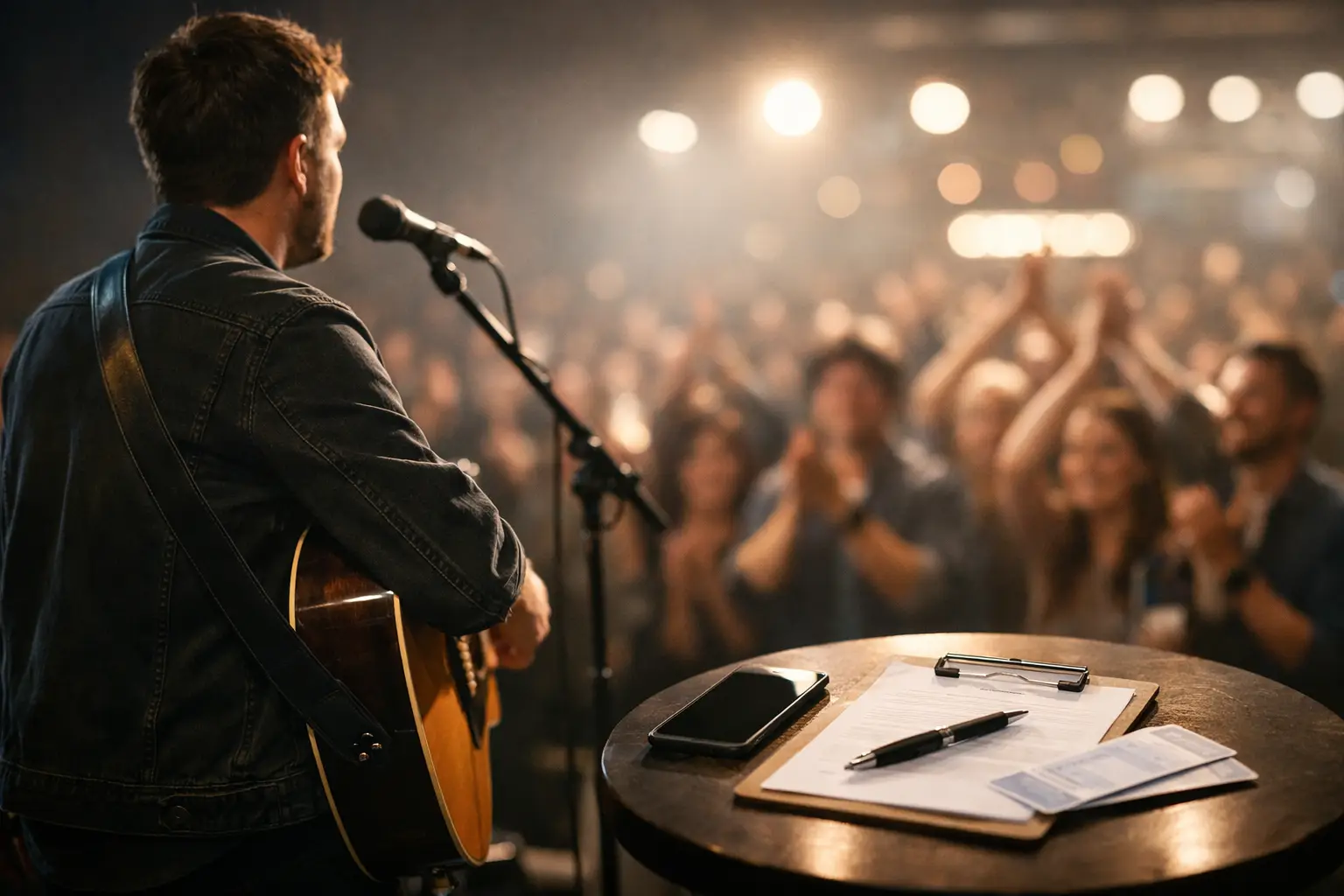
A Thursday slot at the right 150-capacity room can do more for an emerging artist than a poorly matched festival stage in front of people waiting for someone else. Learning how to book better gigs is not about chasing the biggest flyer or sending more cold emails. It is about putting your music in rooms where the audience, promoter, and moment all make sense.
For independent artists, live shows are still one of the clearest tests of momentum. They reveal whether your audience will leave the feed, buy a ticket, bring a friend, follow after the set, and come back next time. The goal is not simply to get booked. The goal is to make every booking create proof that leads to the next one.
Start With the Gig You Can Actually Win
A better gig is not automatically a larger gig. It is a show that fits your current draw, your sound, your location, and the story around your release. An electronic producer with a strong local nightlife following may be better served by a curated late-night event than an early slot at a generalist indie showcase. A singer-songwriter with a thoughtful visual identity may connect more deeply at an art space, listening room, or boutique brand event than at a loud bar where nobody came to listen.
Before reaching out, define what success means for the next three to six months. That could mean selling 50 tickets in your home market, opening for a complementary regional act, collecting audience content for an upcoming release, or proving you can pull listeners in a new city. Each objective points to different rooms and promoters.
Be honest about your draw. Promoters can work with an artist who is developing, but they do not appreciate inflated numbers. If you have 8,000 monthly listeners but only 30 people in a city who reliably show up, pitch yourself as an emerging act with targeted digital reach, not as a guaranteed ticket mover. Credibility gets remembered.
Build a Live Identity Before You Pitch
Promoters book a live proposition, not a streaming profile. Your songs matter, but they need to be supported by a clear sense of what happens when you take the stage. Is the show high-energy and communal? Intimate and lyric-forward? Built around live instrumentation, striking visuals, DJ transitions, or audience participation? Make it easy for someone who has never seen you perform to picture the room.
That does not require a massive production budget. It requires consistency. A tight 25-minute set, clean transitions, confident stage presence, and one strong live clip will usually travel further than an overcomplicated concept that cannot be executed outside a hometown show.
Your basic booking materials should include:
- A short artist bio that says what you sound like, where you are based, and what is happening now.
- One excellent live video, preferably filmed in front of a responsive audience.
- A concise streaming or private listening link featuring your strongest tracks.
- Recent attendance, ticket-sale, or audience data when it supports your pitch.
- High-resolution press photos and direct contact information.
Keep these assets current and easy to access. A promoter should not have to scroll through three years of posts to understand why your act belongs on their bill.
How to Book Better Gigs With Smarter Venue Research
The best outreach starts long before you write an email. Study a venue's last 10 to 20 bills. Look at genre, ticket price, room size, age range, local versus touring acts, and who is actually promoting the shows. A venue may host the event, but an independent promoter, collective, college organization, or local curator may be making the booking decisions.
Pay attention to support slots. If an artist one step ahead of you is playing a room, that is often more useful intelligence than a venue's stated capacity. Look for bills where your sound would complement rather than compete. If you are a moody alt-pop artist, pitching to open for a heavy punk act might be possible, but it will require a clear reason. A bill with adjacent pop, electronic, R&B, or indie acts is usually a more natural first move.
Research also protects your time. Some venues rely heavily on pay-to-play models, excessive ticket quotas, or vague guarantees. Not every ticket responsibility is a red flag, especially for developing artists on a shared bill. But understand the math before agreeing. Ask what the deal includes, whether there is a guarantee, how ticket splits work, when settlement happens, and what promotion the venue or promoter will provide.
A gig that costs you money can still be strategic if it puts you in front of a highly relevant audience or creates strong footage. It is a bad deal when the only plan is for you to sell tickets to people who already know you, with no real path to new listeners.
Write Pitches Like a Collaborator, Not a Applicant
Booking emails should be short, specific, and human. The strongest pitches show that you understand the promoter's world and have a practical reason for reaching out now. Avoid sending the same mass message to every room in a city. People can tell.
Lead with the relevant context: your genre, city, available date range, and a recent signal of activity. That signal might be a new single, a strong hometown turnout, a support slot, press coverage, or an upcoming campaign. Then explain why the fit makes sense. Mention a comparable act they have booked, an event series you genuinely follow, or the kind of audience you believe you can bring.
Keep the ask clear. Are you seeking a support slot, a headline date, a DJ set, a showcase placement, or a co-bill? Do not make the recipient guess. Include two or three links at most, and put your strongest live clip first.
If you do not hear back, follow up once after about a week or two. A polite follow-up is professional. Repeated messages with no new information are not. When you have a meaningful update, such as a sold-out local show or a release performing well in that market, that creates a legitimate reason to reconnect.
Treat the Bill as a Relationship, Not a Transaction
The show begins well before your set time. Arrive prepared, respect the production team, know your input list, and be flexible when the schedule changes. Sound engineers, door staff, photographers, and other artists all influence how a room remembers you. The person who helps solve a last-minute issue is often more valuable to your future than the person whose name is largest on the poster.
Promote like you are part of the event, because you are. Make content that highlights the full lineup, tag the venue and promoter where appropriate, and give your audience a reason to attend beyond “come see me.” If the show has a strong theme, community partner, or local cultural angle, bring that into the story.
At the venue, collect more than applause. Encourage follows, email signups, QR scans, merch conversations, and direct messages. If you are opening, stay for other artists when possible. Congratulate the promoter after the night, thank the team, and share any quality content they can use. These small actions separate artists who simply occupy a slot from artists people want to book again.
Measure What Happened After the Applause
A packed room is gratifying, but numbers tell you whether the show created movement. Track tickets sold, merch revenue, new followers, email signups, streaming lifts in that market, content performance, and the number of industry or artist relationships you made. You do not need a complicated dashboard at first. You do need a simple record of what worked.
Compare results across different kinds of shows. A 40-person independent showcase may generate more real fan conversion than a 300-person event where the crowd was disengaged. On the other hand, a strategically chosen larger support slot can be worth a modest guarantee if it gives you a credible live credit, professional footage, and access to a new market. Context matters.
PaperMedia approaches artist growth as a connected system: visibility, audience intelligence, release planning, and live opportunities should inform one another. If a song is gaining traction in a particular city, that is not just a streaming statistic. It is a reason to identify local curators, build a targeted pitch, and test a room that matches the record.
Build Toward Offers Instead of Chasing Them
The long-term shift happens when your live reputation reaches promoters before your email does. That comes from repeatable proof: good sets, reliable promotion, respectful conduct, useful content, and an audience that responds. It also comes from being part of a scene rather than treating every city like a transaction.
Go to shows when you are not performing. Meet artists whose audiences overlap with yours. Support local DJs, photographers, producers, and event teams. A genuine relationship can lead to a co-bill, a referral, or a last-minute opening that no submission form would have delivered.
Book the room that gives your next song, next release, or next market a real chance to grow. Then leave that room with enough evidence that the next promoter sees more than potential - they see momentum.
