
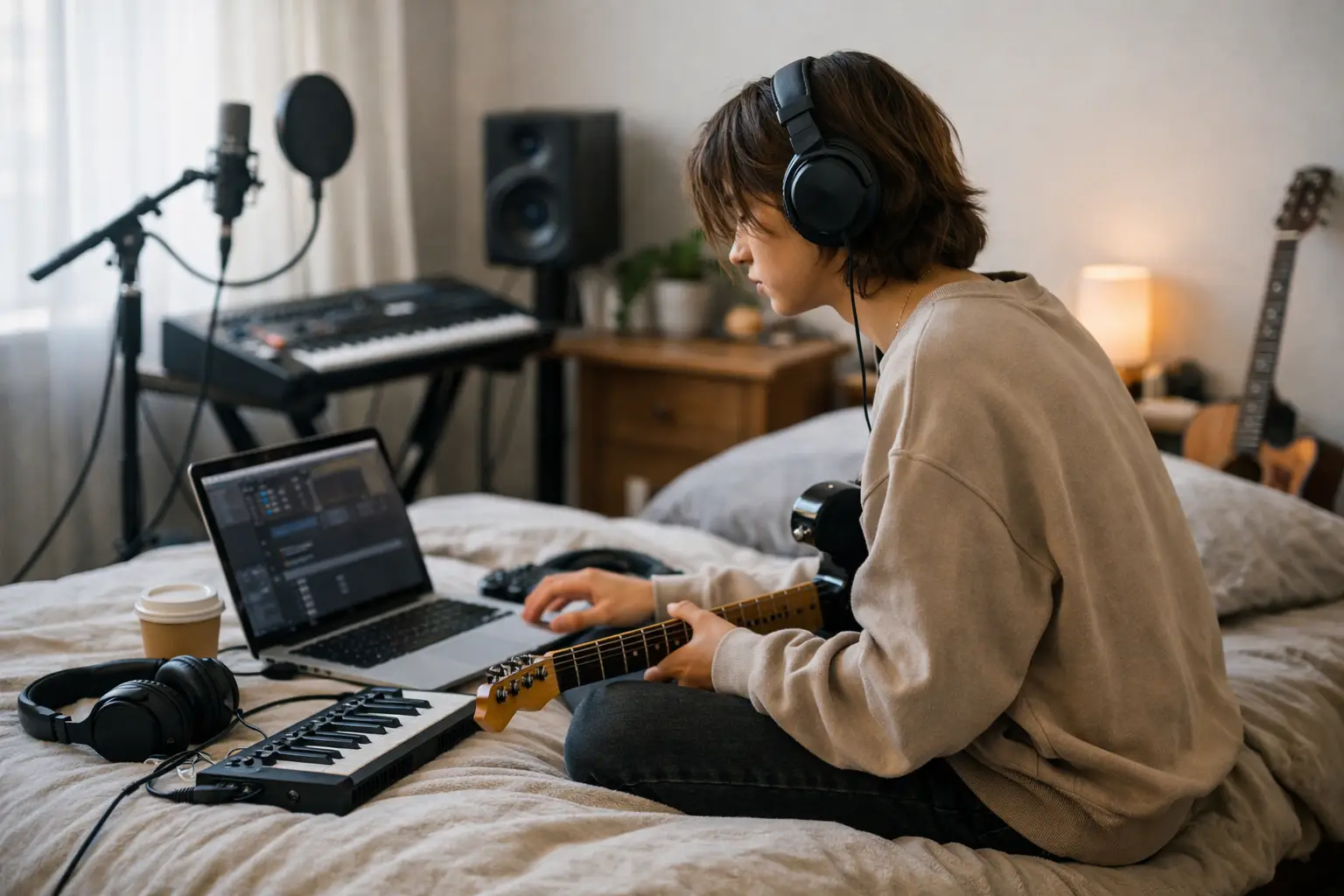
A lot of genres get named after sound. Bedroom pop got named after circumstance.
That detail matters because bedroom pop was never just about soft vocals, chorus-coated guitars, or lo-fi drums tucked under a vocal that feels half-confession, half-voice note. At its core, bedroom pop describes a way of making music that collapsed the distance between artist and listener. The room became the studio. The limitation became the aesthetic. And for independent artists, that shift changed much more than production style - it changed how careers could start.
What bedroom pop actually is
Bedroom pop is a loose tag for music created with DIY tools, intimate production, and a strong sense of personal atmosphere. The genre sits somewhere between indie pop, lo-fi, alt-pop, dream pop, and singer-songwriter music, but it is not cleanly boxed into any one lane. That flexibility is part of why the term stuck.
In practice, bedroom pop usually favors closeness over scale. Vocals are often dry or lightly processed, as if the singer is only a few feet away. Drums can feel softened or imperfect. Synths, guitar layers, ambient noise, and tape-like textures often carry as much emotional weight as the hook itself. The songs may sound casual, but the best ones are carefully arranged to feel unguarded.
That distinction is where a lot of people miss the point. Bedroom pop is not simply unfinished music or low-budget music. It is music where intimacy is part of the design.
Why bedroom pop took off when it did
The rise of bedroom pop was tied to access. Affordable DAWs, USB microphones, laptops powerful enough to run full sessions, and a generation raised on SoundCloud, YouTube, Bandcamp, and later TikTok made it possible to release songs without studio gatekeepers. You no longer needed expensive room time to make something emotionally convincing.
But access alone does not explain the cultural pull. Bedroom pop also arrived at a moment when audiences were exhausted by polish for polish's sake. Pop music had become extremely precise. Bedroom pop offered the opposite kind of luxury - personality, imperfection, and the feeling that the artist had not been filtered beyond recognition.
That is why so many breakout artists in this space felt immediate from day one. Listeners were not just hearing songs. They were hearing process, environment, vulnerability, and identity all at once. The line between demo and finished record got blurry, and that blur became commercially viable.
The sound is smaller. The ambition usually isn't.
One of the biggest misconceptions around bedroom pop is that it is inherently minor league. It gets framed as a starter genre, as if artists make bedroom pop until they can afford to make something "real." That is outdated.
Some artists absolutely begin there and evolve toward cleaner, bigger, more conventionally produced records. Others keep the DNA of bedroom pop even after scale arrives because that sonic intimacy is the point, not a placeholder. What changes is not always fidelity. Often it is control. Artists learn how to make a track feel personal without sounding accidental.
From an industry standpoint, that has made bedroom pop unusually powerful. It translates well to streaming, where low-stakes replayability matters. It clips well into short-form content because understated songs can carry mood without overpowering the visual. It also builds strong artist branding because the sound often matches a believable identity - self-made, emotionally literate, aesthetically coherent, and digitally native.
Bedroom pop as branding, not just genre
For independent artists, bedroom pop works as both a musical language and a market signal. When listeners, editors, managers, or publicists hear that label, they often picture more than the sonics. They picture a world.
That world usually includes handmade visuals, close-up photography, diaristic lyrics, understated fashion, a soft but specific palette, and a release strategy that feels organic even when it is planned. The strongest bedroom pop artists understand this instinctively. They are not only producing tracks. They are producing context.
That is also why the genre can be a blessing and a trap. The blessing is recognizability. A clear aesthetic helps artists get placed, pitched, and understood quickly. The trap is that once a scene hardens into an algorithm-friendly look and sound, imitation floods in. Intimacy becomes posture. Lo-fi choices become branding shorthand rather than emotional decisions.
When that happens, listeners can tell.
What makes bedroom pop work - and what makes it feel fake
The bedroom pop records that last tend to share a few qualities. They have melodic clarity, even when the arrangement feels hazy. They have point of view, not just mood. And they sound small on purpose.
That last part is important. There is a difference between controlled understatement and underdeveloped production. A quiet mix can feel magnetic if the vocal tone, harmonic choices, and rhythmic pocket are intentional. The same track can feel flat if the artist is hiding behind reverb and calling it vulnerability.
Lyrics matter here too. Bedroom pop often leans conversational, but conversational does not mean careless. The best writing in the space captures specific emotional detail without over-explaining it. It feels lived in. One sharp image can do more than a full verse of vague sadness.
For artists building in this lane, the question is not whether your song sounds homemade. The question is whether it sounds believable.
How the genre changed once the industry caught up
As bedroom pop became a recognized category, the ecosystem around it professionalized fast. Playlists got more targeted. Visual references became more repeatable. Labels began scouting artists whose early traction came from home-recorded releases and strong audience identification. What started as anti-friction music entered a highly structured discovery economy.
That created real opportunity. Artists no longer had to wait for traditional validation to prove audience demand. A well-positioned release with the right visual language, metadata, short-form strategy, and editorial pitch could create movement without a massive team.
It also created pressure. Once a genre associated with privacy becomes optimized for constant visibility, some of its appeal can thin out. Bedroom pop has had to survive its own marketability.
That is why the artists still breaking through in this space usually bring one of two things: exceptional songwriting or a perspective strong enough to bend the genre around them. The middle ground is crowded.
If you're making bedroom pop, here's the real opportunity
The opportunity is not just to sound current. It is to build trust.
Bedroom pop gives independent artists a rare advantage in a market full of overstated positioning. It lets you lead with emotional proximity. If the music is strong, audiences often feel invested earlier because the songs imply access, honesty, and authorship. That makes every other layer of growth more effective, from social storytelling to PR angles to playlist pitching.
But the genre only works long term if the infrastructure matches the aesthetic. If your sound says intimate and intentional, your release plan cannot feel random. Your visual identity cannot shift every two weeks. Your metadata, distribution timing, press assets, and platform presence need to support the same story the music is telling.
This is where a lot of promising artists stall. They understand the vibe but not the system around it. Great bedroom pop can still disappear if it is not packaged, positioned, and delivered properly. In a crowded field, subtle music needs sharp execution.
That is also why platforms like PaperMedia sit in an interesting place within this conversation. Bedroom pop is a culture story, but it is also an operations story. Discovery matters. So do timing, campaign structure, media relationships, and audience retention after the first spark.
Is bedroom pop still relevant, or has it already peaked?
The label may be less fresh than it was a few years ago, but the core idea is not going anywhere. Audiences still respond to closeness. Artists still want flexible production methods. And the economics of independent music still reward creators who can make compelling work without waiting for institutional permission.
What is changing is the surface language. Some artists avoid the term because it can feel overused or flatten different sounds into one playlist category. That hesitation is fair. Genre tags can become lazy shorthand. But even when artists reject the label, the influence remains everywhere - in vocal treatment, arrangement choices, visual storytelling, and the expectation that an artist's world should feel personal from the first listen.
So yes, bedroom pop still matters. Maybe less as a trend report, more as a blueprint.
For artists and industry teams, that blueprint is worth paying attention to. It proved that a song made in a small room could compete globally if it carried identity, emotional precision, and a believable world around it. The room was never the limitation. It was the proof of concept.
